

Ethernet PoE Switch – Simplifying Modern Network Connectivity

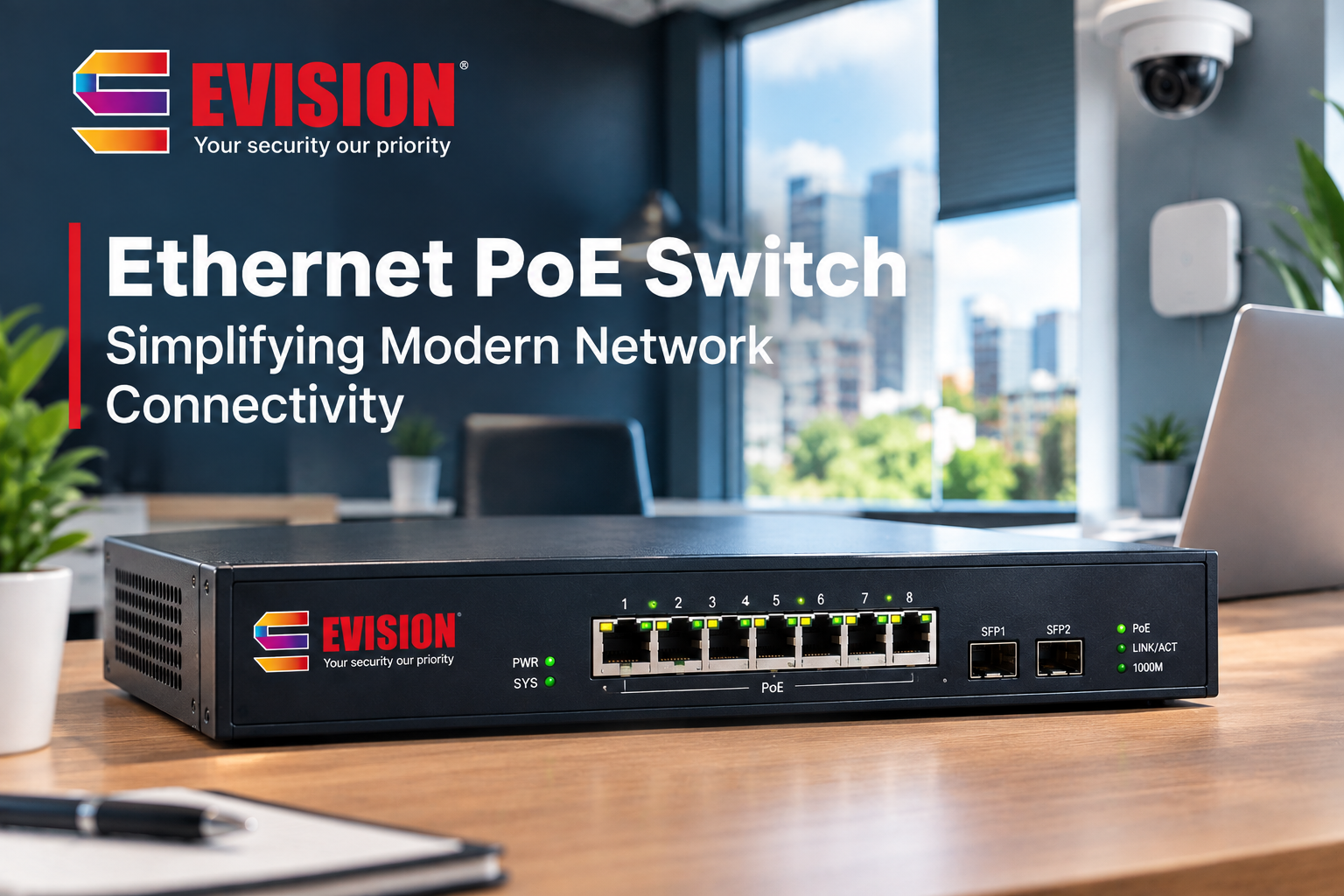
Modern businesses rely on connected devices for security, communication, wireless access, and daily operations. As the number of network devices increases, organizations need a networking solution that can provide reliable data connectivity while simplifying power management. An Ethernet PoE Switch can help address both requirements through a single network infrastructure.
Power over Ethernet (PoE) allows compatible devices to receive electrical power and network data through the same Ethernet cable. This makes PoE technology particularly useful for IP cameras, wireless access points, VoIP phones, and other compatible devices. E-vision provides networking and surveillance solutions designed to support modern connectivity requirements.
What Is an Ethernet PoE Switch?
An Ethernet PoE Switch is a network switch that combines standard Ethernet connectivity with Power over Ethernet functionality. It can transmit network data while supplying power to compatible PoE devices through Ethernet cables.
Instead of using separate power adapters and network cables, compatible devices can use a single cable for both functions. This can help simplify installations and improve cable organization.
Common PoE-enabled devices include:
- IP CCTV cameras
- Wireless access points
- VoIP phones
- Access control systems
- Network security devices
- Other compatible smart devices
How Does PoE Improve Network Installation?
Simplified Cabling
PoE can reduce cabling requirements because one Ethernet cable can carry both data and power to compatible devices. This is useful when devices are installed in locations where electrical outlets are limited.
Centralized Connectivity
A PoE switch provides a central point for connecting multiple network devices. This can make network infrastructure easier to organize and maintain.
Flexible Device Placement
Since compatible devices can receive power through Ethernet, they can be installed in locations where running separate power cables may be inconvenient.
Easier Expansion
Businesses can add more network devices as their requirements grow. Selecting a switch with adequate ports and power capacity can help accommodate future expansion.
Key Features to Consider
Before selecting an Ethernet PoE Switch, businesses should evaluate their network and device requirements.
Port count: Choose a suitable number of ports based on current devices and planned expansion.
PoE power budget: Calculate the total power requirements of connected devices and ensure the switch provides sufficient capacity.
Network speed: Gigabit Ethernet can be useful for high-bandwidth applications such as high-resolution CCTV, video conferencing, and large data transfers.
Uplink options: SFP or fiber uplinks can provide additional flexibility for connecting network segments over longer distances.
Managed or unmanaged: Managed switches offer greater control over network configuration and monitoring, while unmanaged switches are generally simpler to deploy.
Device compatibility: Check the PoE standards and power requirements of connected devices before installation.
Ethernet PoE Switch for CCTV Systems
IP surveillance is one of the most common applications of PoE networking. CCTV cameras can be installed across offices, warehouses, retail stores, industrial facilities, and residential complexes.
An Ethernet PoE Switch can connect compatible IP cameras and provide power through the same Ethernet connection. This can help reduce cable clutter while creating a centralized surveillance network.
When designing a CCTV network, consider camera resolution, bandwidth requirements, PoE power consumption, number of cameras, uplink capacity, and transmission distance.
Other Applications of PoE Networking
PoE technology is not limited to CCTV systems. It can support various business and commercial applications, including:
- Wireless access points
- VoIP telephone systems
- Access control devices
- Smart building equipment
- Network monitoring devices
- Security and automation systems
The appropriate switch depends on the number and type of connected devices and the network’s performance requirements.
How to Choose the Right PoE Switch
Start by identifying all devices that need network connectivity and determine which ones require PoE. Then calculate the total power requirements and select a switch with sufficient PoE capacity.
Next, evaluate the number of ports, network speed, uplink requirements, and management features. For larger networks, leaving additional ports for future devices can make expansion easier.
For CCTV applications, also consider camera resolution and video traffic to ensure the network has adequate bandwidth.
Why Choose E-vision?
E-vision offers networking and surveillance solutions for modern security and connectivity requirements. Its range includes Ethernet switches, PoE networking products, CCTV cameras, and AI-based surveillance solutions.
By selecting networking equipment according to port requirements, power consumption, bandwidth, and installation needs, businesses can create a more organized and scalable infrastructure.
Conclusion
Reliable connectivity is essential for modern businesses and security systems. An Ethernet PoE Switch can simplify network installation by combining data connectivity and power delivery for compatible devices through Ethernet.
Before choosing a switch, consider port count, PoE power budget, network speed, uplink options, device compatibility, and future expansion. With suitable networking solutions from E-vision, businesses can develop a structured network that supports their evolving connectivity and surveillance requirements.
Frequently Asked Questions
1. What is an Ethernet PoE Switch?
It is a network switch that provides Ethernet connectivity while delivering power to compatible PoE devices through the same Ethernet cable.
2. Can an Ethernet PoE Switch power IP cameras?
Yes. Compatible PoE IP cameras can receive both network data and electrical power through an Ethernet connection.
3. How do I determine the required PoE power budget?
Add the power requirements of all connected PoE devices and select a switch with sufficient total PoE capacity and additional headroom where appropriate.
4. Is Gigabit Ethernet suitable for PoE networks?
Yes. Gigabit Ethernet can be suitable for applications requiring higher bandwidth, including multiple high-resolution IP cameras and other data-intensive devices.
5. Can PoE be used for devices other than CCTV cameras?
Yes. Compatible wireless access points, VoIP phones, access control systems, and various smart network devices can also use PoE.